
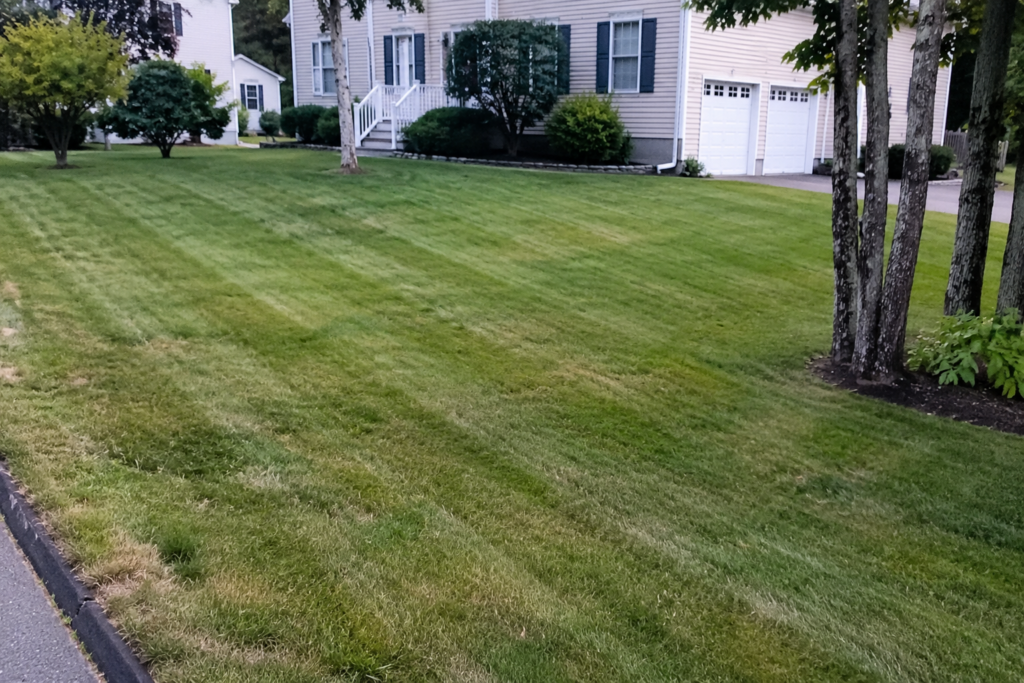
Mowing your lawn in the same direction every week causes grass blades to lean permanently, creates visible ruts or stripes, and can compact soil over time. Rotating your mowing pattern keeps grass growing upright, promotes even wear, and results in a healthier, better-looking lawn.
A homeowner in Windham, NH recently reached out to let us know their lawn had developed noticeable lines from repeated mowing in the same direction over several months. It’s a common issue, and honestly, an easy one to fix once you understand what’s happening beneath the surface.
At Trimmers Landscaping, we think every homeowner should understand why this happens and what a good mowing routine actually looks like.
What Happens When You Always Mow in the Same Direction?
Grass blades get trained to lean the way the mower pushes them, and over time that lean becomes permanent. You also start to see “grain” in the turf, similar to carpet fibers all pressed one way. In more severe cases, the mower wheels track the same path repeatedly, which compacts the soil underneath and stresses the grass roots.
- Visible stripes or lines that don’t fade between cuts
- Grass that looks patchy or uneven from certain angles
- Compacted soil strips where wheels repeatedly travel
- Turf that struggles to stand upright on its own
None of these are catastrophic on their own, but left uncorrected they do add up. The good news is that simply changing direction fixes most of it.
How Often Should You Rotate Your Mowing Pattern?
Ideally, you should change your mowing direction every single visit. At minimum, aim to rotate the pattern every other cut. The more variety you introduce, the more evenly the grass grows and the less stress you put on any one area of the lawn.
There are a few common patterns to rotate between:
- North to south (straight vertical passes)
- East to west (straight horizontal passes)
- Diagonal (45-degree angle passes)
- Alternating diagonal (opposite 45-degree angle next visit)
You do not need to follow a strict schedule. Just make it a habit to go a different direction than you did last time. Our crews follow this practice as part of our weekly mowing service because it genuinely makes a difference in turf quality over a full season.
Does Cutting Height Play a Role Too?
Yes, mowing height and mowing direction work together to keep your lawn healthy. Cutting grass too short weakens the root system and makes directional stress worse. Most cool-season grasses common in Windham, NH do best at a height of 3 to 3.5 inches during the growing season.
Dropping the blade just a little lower than usual on occasion is fine, but scalping the lawn consistently will cause more damage than any mowing pattern issue. If you are unsure what height works best for your specific turf, our team is happy to walk you through it. You can learn more about us and our approach on our about page.
Frequently Asked Questions
Will the lines in my lawn go away on their own?
In most cases, yes. Once you start rotating your mowing direction, the grass blades will gradually stand back up and the lines will fade over a few cutting cycles. If the soil underneath has been compacted, light aeration can help speed up the recovery.
Does this apply to riding mowers and zero-turns too?
Absolutely. In fact, riding mowers and zero-turns are heavier than walk-behinds, which means they compact soil faster when tracking the same path. Rotating patterns is just as important, if not more so, with larger equipment.
What if my yard shape makes it hard to mow in different directions?
Odd-shaped yards can make strict pattern rotation tricky, but even a slight angle change makes a real difference. Going diagonal when you normally go straight, for example, is enough to reduce the repetitive stress on the turf.
If your lawn has developed deeper ruts or bare patches from repeated compaction, our lawn renovation services can help restore it.
Ready for a Lawn That Looks Great All Season?
Small habits make a big difference when it comes to lawn care. If you want a crew that pays attention to the details, we would love to help. Homeowners across Windham, NH trust us to keep their lawns healthy week after week. Contact us today to talk about what your lawn needs this season.


